Blog 1

Chips That Changed the World: Why Semiconductors Are the Real Unsung Heroes of Tech!

Think about the last time you scrolled through social media, hailed a cab, or streamed your favorite show. Now think about doing all of that without the teeny-tiny silicon chips that enable it. Tough to imagine, yeah? That’s because semiconductors, even though they’re invisible to most of us quietly drive the modern world.

From smartphones and laptops to electric cars, medical devices, satellites, and AI systems, semiconductors are ubiquitous. They’re the reason our devices are smaller, faster, and smarter. But, unlike shiny toys or trending apps, chips never get the limelight. They’re the behind-the-scenes team of technology, invisible but totally vital.

One individual with first-hand experience in this sector is Mr Kedar Patankar, a semiconductor engineering executive who worked for more than two decades in the USA, including Minneapolis and Silicon Valley, in advanced chip design. With two master’s degrees from a leading U.S. university and high-tech company leadership, he has experienced firsthand how chips evolved from mere circuit parts to building blocks of today’s civilization. Now, he is again in his homeland, resident in Pune, and continues to utilize his experience as a business head and executive for two startups with more than 100 engineers involved in next-generation semiconductor solutions.

But here’s the larger picture: the world is vying to lock in its semiconductor future.

Global developments over the past few years — from supply chain disruptions to geopolitical tensions — have laid bare how much countries rely on chips. A shortage of semiconductors can bring car factories to a halt, delay smartphone launches, and even impact national security. That is why nations from the U.S. to Japan, South Korea, Taiwan, and the European Union are putting huge investments to build up their semiconductor ecosystems.

And India is also entering this race. The Indian Government has made bold plans to position the nation as a global hub for chip design and manufacturing. With policy backing, incentives, and collaborations with top global players, India is seeking to cut imports and establish a self-reliant semiconductor ecosystem. For a nation with such a large digital economy and an expanding technological ambition, semiconductors are not merely about technology — they are about sovereignty and future preparedness.

Such analysts as Kedar Patankar point out that it is an urgent and timely concern. As AI, quantum computing, electric mobility, and clean energy gain prominence, advanced semiconductors will be needed many times more. Having talent and ecosystem available today is being future-ready tomorrow.

So the next time you grab your phone or jump into a connected car, remember: it’s not magic, it’s semiconductors the quiet heroes of our contemporary world. And as the chip race intensifies globally, India can have an opportunity to not only consume this technology but also lead in defining its future.

B - 5

The Multiple-box Life: How to Fit Multiple Passions Into a Single Lifetime!

We’ve all heard the advice: “Pick one thing and stick to it.” It sounds noble, disciplined, even logical. But here’s the truth: life is far too big, rich, and unpredictable to fit neatly into just one box.

Some are born specialists. They drill one well, descend deep, and hit water. Some of us, however? We’re built differently. We desire to drill many wells not because we’re flighty, but because we love the look of varied landscapes.

I refer to this as the multiple-boxes Life, a style of living in which your passions, projects, and pursuits each have their own compartment.

Life Isn’t One Big Box
Envision your life as a super-sized moving truck. If you simply throw all the items into one super-sized box, it ends up being messy, knotted, and chaotic. But if you use smaller, nicely labeled boxes, you have a clue about where things go and you can open whatever one that spurs you at the moment.

One box could be your professional life.
Another could be your passion for the planet.
Another may be an activity such as painting, photography, hiking, or writing.
And yes, occasionally you’ll place new boxes on top of older ones, or replace them altogether.

This way, you don’t need to leave behind a passion for exploring another you just put it in its box, safe and available, until you’re ready to open it up again.

The Myth of “One True Calling”
We idealize the notion of discovering that one thing we’re supposed to do. But here’s the truth your “one thing” at age 25 may not be your “one thing” at age 45. Passions change, priorities shift, and opportunities surprise you.

When you live the Small-Box Life, you’re free to change without apology. You’re not betraying your past dreams, you’re just adding new ones to the list.

Serving Your Future Self
Each box you create today is a present for the person you’ll be tomorrow.

Pursue that book thought, even though you are not yet an author. Learn that digital marketing course, even though your current job is in engineering. Learn pottery, even if you’ve never handled clay in your life.

Because in five, ten, or twenty years from now, your future self may reach for that skill, that recollection, that experience and find it waiting there.

But Won’t It Be Too Much?
This isn’t a matter of doing everything at once.
It’s a matter of doing sufficient of each to keep the spark going. It’s about rotation, not overload.

Some seasons, one box will claim more of your time.
Other seasons, another box will be in the spotlight.
The skill is knowing when to make the change, and never allowing a box to become too stale.

Your Boxes Tell Your Story
Ultimately, your life will not be about the size of your primary box it will be about the depth of the set.

And when someone asks you “What do you do?” you can smile and respond:
“I live the multiple-boxes Life. I’m building many stories at once.”

Don’t minimize your life to fit a single label, single role, or single predictable path. You get to be a mosaic, not merely one tile. And if you show up for all your boxes, one day your future self will thank you for the guts to live richly, broadly, and unapologetically.

Blog 1

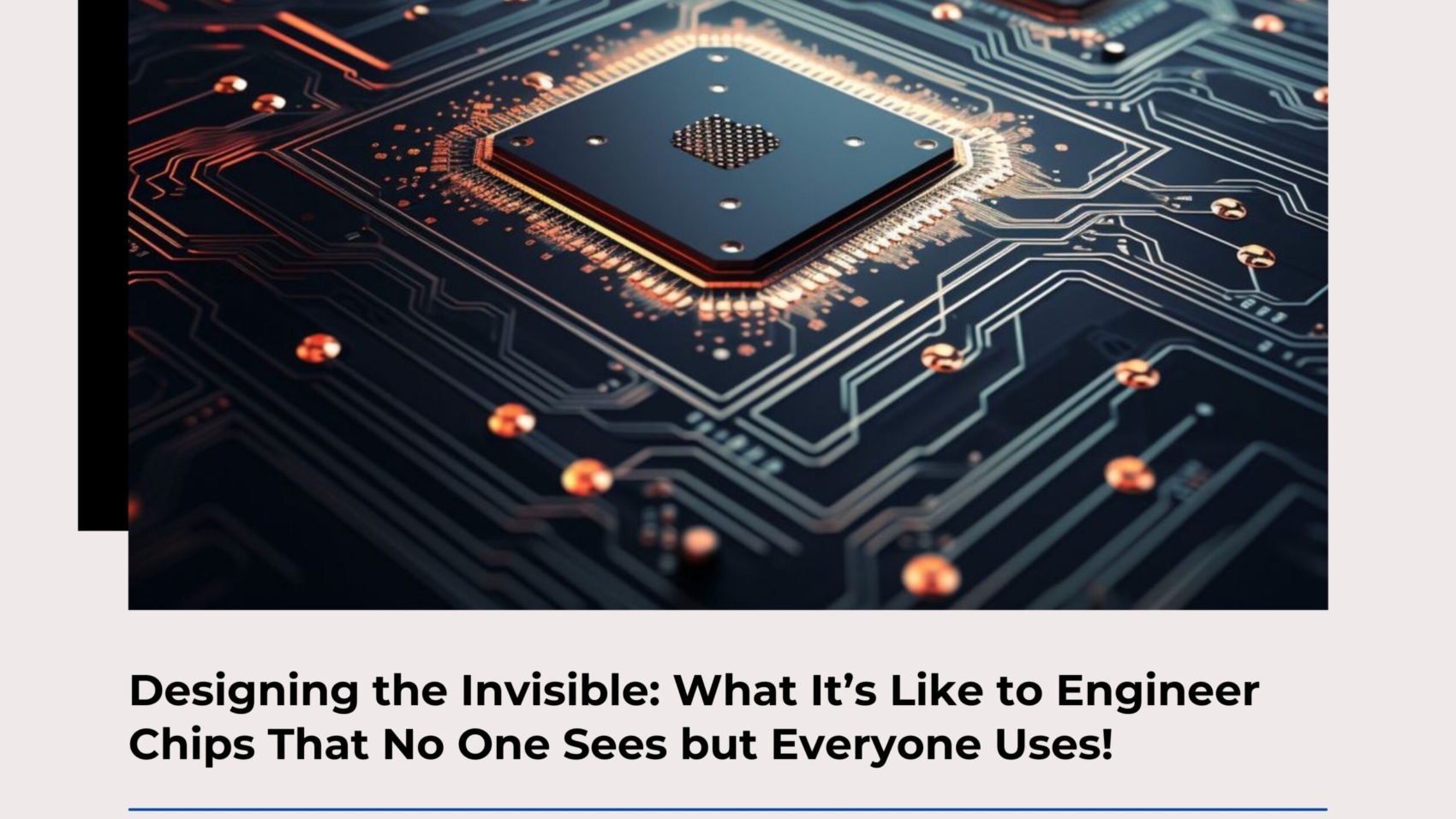
Designing the Invisible: What It’s Like to Engineer Chips That No One Sees but Everyone Uses!

We live in a world that worships the visible.

Shiny screens. Futuristic gadgets. Sleek designs. The things we can touch, swipe, or share are the things we tend to value. But behind every glowing screen and every smart device lies a world that’s unseen — and almost always unappreciated.

That’s the world I’ve spent most of my life in.

For over two decades, I’ve worked in the semiconductor industry — first in Silicon Valley and now back in India, helping lead two startups as a business head and executive, with teams of 100+ engineers building products that are shaping tomorrow. Our work? Designing and engineering the invisible. And trust me — it’s anything but boring.

The Power Behind the Curtain
Most people don’t think about the chip inside their phone, laptop, electric car, or smart speaker. And why should they? It’s not designed to be seen. But every swipe, ping, and “Hey Siri” happens because a chip, somewhere inside, is doing its job with microscopic precision.

Working on these chips is like designing a city the size of your fingernail — a city where traffic can’t jam, power can’t drop, and every connection needs to be perfect. It’s equal parts science fiction and hardcore engineering.

The irony? If we do our job perfectly, no one will ever know. The device will “just work.” And that’s the point.

Pressure Without Applause
People think the tech world is all hoodies and hackathons. But chip engineering? It’s pressure-packed in a very different way.

One tiny design flaw in a chip layout can cost millions in re-fabrication. Delays ripple through global supply chains. You don’t get do-overs — you get consequences. And yet, most of this work happens in the background, in sterile labs and quiet offices, far from the glamour of product launches and keynote stages.

The joy here is different. It’s in knowing your work sits inside a medical device saving a life, or a car navigating safely through a storm, or a satellite streaming education to a village school. It’s invisible, yes. But it matters.

Startups, Scalability, and Solving What’s Next

B - 3

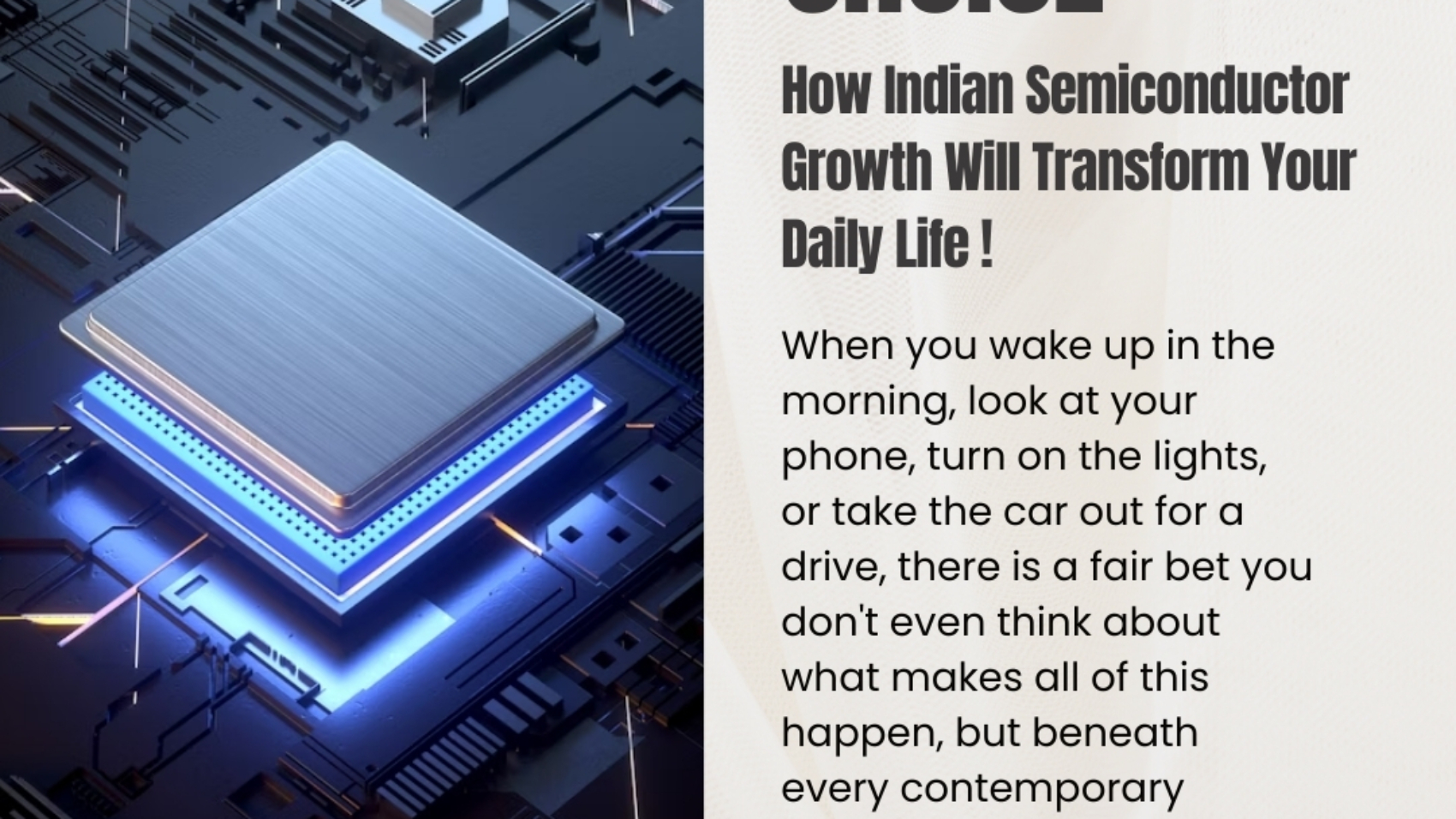
From Chips to Choices : How Indian Semiconductor Growth Will Transform Your Daily Life!

When you wake up in the morning, look at your phone, turn on the lights, or take the car out for a drive, there is a fair bet you don’t even think about what makes all of this happen, but beneath every contemporary gadget and intelligent solution is a tiny, high-powered slice of technology “the Semiconductor-Chip”.

India has long been a software powerhouse for decades. But now, it’s boldly going into the semiconductor arena, those small silicon brains that energize everything from your smartphone to high-end medical equipment. And this move isn’t solely about commerce or national ego. It’s about revolutionizing the way every Indian works, lives, and interacts with tech.

Why Semiconductors matter more than ever?

Semiconductors are the unsung heroes of the digital world. They are hidden in devices we use every day:

The phone in your pocket

The electric car you drive

The medical equipment saving lives in hospitals

The communication networks connecting us all

But here’s the catch: India has depended to a large extent on imported semiconductors from Taiwan, South Korea, and the U.S. That exposed us to global supply chain outages and increasing costs. The COVID-19 pandemic came as a rude wake-up call when the world struggled to get enough chips for basic products.

That is why the Indian government’s aggressive drive to develop a local semiconductor ecosystem is a game-changer. With policies encouraging chip design, manufacturing, and innovation, India is well on its way to moving away from being a consumer of technology to becoming a powerhouse producer.

What this means for your daily life?

More Affordable Devices
As manufacturing at home is ramped up, prices of devices such as smartphones, laptops, and smart home appliances will come down in the long run. That is better technology in your pocket at affordable prices.

Faster, Smarter Solutions
India’s semiconductor development is not merely about producing more chips; it’s about producing improved chips — chips built with India’s specific needs in mind. Consider wiser energy meters, sophisticated health-tracking wearables, and more effective industrial automation aiding businesses small and large.

Job Creation & Innovation
The semiconductor boom is already generating tens of thousands of high-skilled employment opportunities. Innovators, designers, and engineers are creating homegrown technology solutions that allow India to compete with the world and inspire young minds to think big.

Better Digital Infrastructure
Quicker internet, enhanced mobile connectivity (say hello, 5G!), and reliable cloud solutions depend on high-end chips. This translates into a better experience in online education, telemedicine, and digital government services, particularly in rural India.

Sustainable Technologies
As India drives towards electric mobility and renewable energy, effective semiconductor solutions will assist in constructing cleaner, smarter energy grids and green electric vehicles.

People Behind the Progress

Industry leaders like Kedar Patankar are at the forefront of this revolution. With over two decades of semiconductor engineering experience in Silicon Valley and Minneapolis, Kedar now helps lead startups in India that develop innovative semiconductor solutions. His work is a powerful example of how expertise is being redirected to serve India’s growth, creating technologies that not only power devices but power lives.

A Future You’ll Feel Every Day

The semiconductor business is not just about factories or boardrooms anymore. It’s a matter of making decisions

The decision to purchase affordable, quality technology.

The decision to receive better healthcare through advanced devices.

The decision to live responsibly with smarter energy solutions.

Over the next few years, as India’s semiconductor industry expands, you won’t just hear news headlines about “chip wars” or “supply chains.”
You’ll experience it in your pocket, your home, and your workplace.

Because at the end of it all, semiconductors are not merely about technology, they’re about making every Indian live smarter, easier, and more connected.

Blog 1

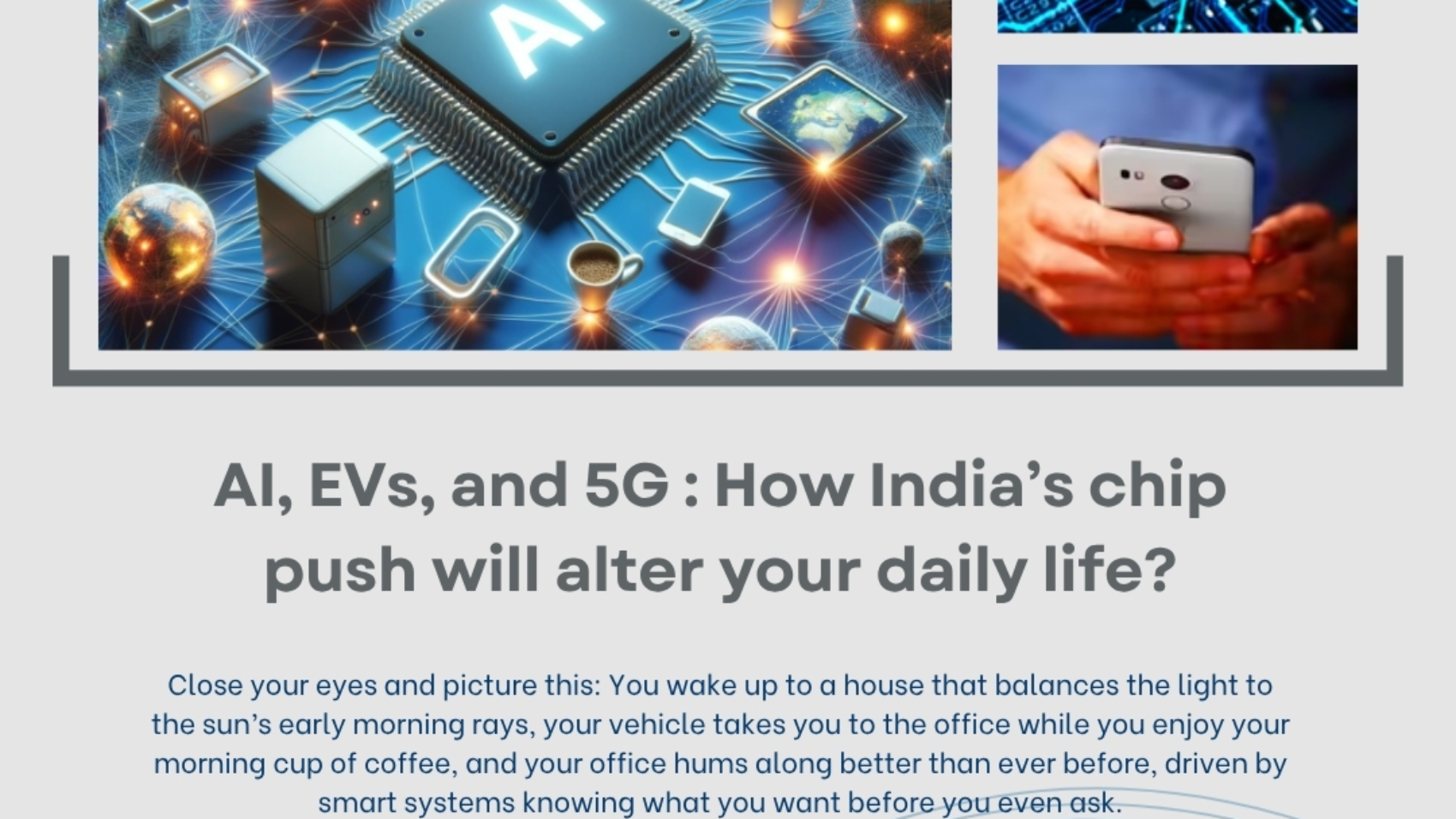
AI, EVs, and 5G : How India’s chip push will alter your daily life?

Close your eyes and picture this: You wake up to a house that balances the light to the sun’s early morning rays, your vehicle takes you to the office while you enjoy your morning cup of coffee, and your office hums along better than ever before, driven by smart systems knowing what you want before you even ask.

This is not science fiction. This is the India of the future, constructed upon the smallest but most potent building block of technology, “the semiconductor chip.

The Chip That Runs the World

Semiconductors may not be seen, but they are ubiquitous in your phone, your laptop, your smartwatch, your automobile, your credit card, and even in your washing machine. They are the very center of today’s innovation.

India has been the globe’s software brain for decades, but not its hardware heart. That’s about to change, and rapidly so.

The Indian government’s ambitious Semicon India programme and enormous chipmaking incentives are going to make the nation a world semiconductor leader. And the effects won’t be limited to factories or boardrooms alone; they will reverberate through your lifestyle, remapping the way we live, work, and travel.

1. AI at Home: Smart Living, Smarter Chips

Your “smart” devices are only as smart as the chips inside them. As India ramps up chip design and production, we’ll see more accessible, locally made technology powering our homes.

Think about it, refrigerators that order groceries before they run out, fans that adjust speed with room temperature, and AI assistants that truly understand regional languages.

With local chip innovation, smart home appliances will be cheaper, more stable, and more tailored to Indian homes.

2. EVs on the Road: Chipping Away at the Revolution

Electric Vehicles (EVs) are not just about batteries; they’re about brains.
All EVs depend on semiconductors for everything from navigation and energy management to safety features and motor control.

India’s rapidly growing EV market is soon set to receive a massive boost from the semiconductor tsunami. With domestic chip production increasing, get ready for EVs that are smarter, more affordable, and more efficient, designed for Indian roads, climate, and people.

With faster chips comes faster innovation. Imagine self-parking vehicles, traffic-responsive routing, and cars that talk to city infrastructure. The motorways of the future will essentially speak back.

3. 5G and Beyond: Bridging a Country in Real Time

5G is the digital spine of today’s world, but a concept without chips. Semiconductors enable the super-fast, low-latency connections of 5G.

When India is deploying 5G in cities and towns, indigenous chips will power smoother connections, stronger signals, and real-time communication.

From telemedicine in far-flung villages to augmented education driven by AR/VR, semiconductors will compress distances and create opportunities.

And when 6G and satellite internet systems become available, India will already possess the chip infrastructure to drive the next digital shift.

4. Workspaces Redefined: From Silicon Valley to Silicon Bharat

Automation, artificial intelligence, and robotics are transforming the way we work, and all of them are based on chips.

With India investing heavily in semiconductor startups and R&D, we’re looking at an economy that won’t just consume technology but will create it.
From precision agriculture systems to AI-driven healthcare diagnostics, chip innovation will open new industries and job roles across the country.

The shift will be massive, empowering engineers, designers, and entrepreneurs to build products made in India, for the world.

The Bigger Picture: Empowering Every Indian

Industry leaders such as Kedar Patankar, a veteran semiconductor engineering executive with more than two decades of international experience, take the view that this revolution is not merely technological, it’s social.

By developing indigenous semiconductor engineers and innovation, India is building a future that is more inclusive, accessible, and affordable.
It’s not about chips, it’s about choices.
Choices that reshape the way we live, learn, and lead.

The Future Is Smaller and Smarter

In the years to come, each click, each drive, each call, and each connection will be conditioned by the success of India’s chip story.

The smallest chip will bring the greatest transformation, from homes to highways, from factories to families.

So next time your car starts itself or your house welcomes you with ideal lighting, just remember, it all started with a silicon chip, and a country daring enough to construct its own.